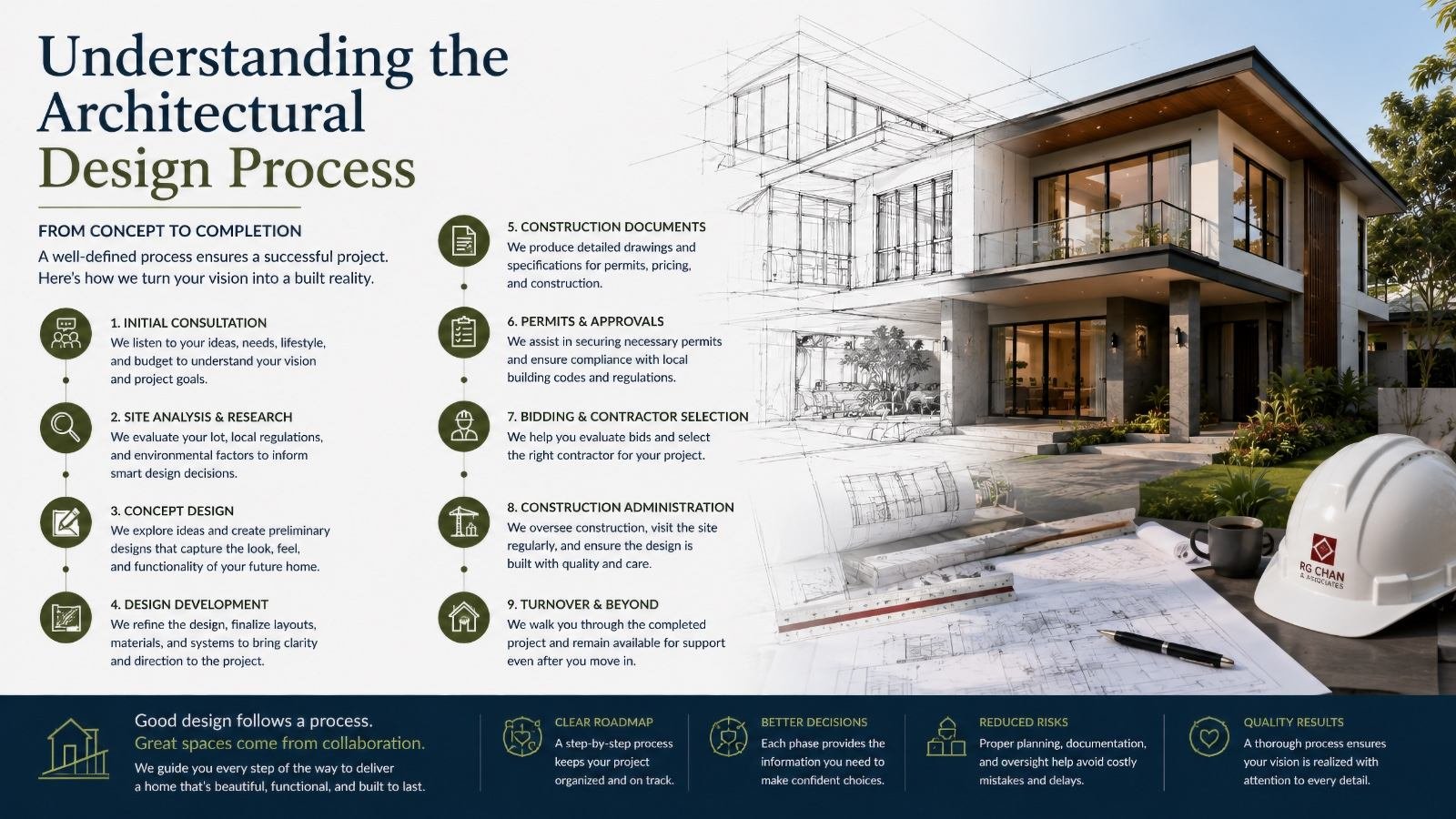
For many clients, building a home, commercial facility, or institutional project is a once-in-a-lifetime undertaking. While most people focus on the finished building, relatively few understand the structured process required to transform an idea into a successful completed project.
Since establishing RG Chan & Associates in 1982, I have guided clients through every stage of project development. One lesson has remained consistent: successful projects rarely happen by chance. They result from a disciplined design process that helps manage risk, control costs, and support informed decision-making.
Understanding this process allows owners to participate more effectively and confidently throughout the life of their project.
1. Initial Consultation
Every project begins with a conversation.
This stage focuses on understanding the client's objectives, lifestyle requirements, operational needs, budget considerations, and long-term goals. Whether designing a retirement residence, a commercial facility, or an institutional building, the project must begin with a clear understanding of what success looks like for the owner.
Good projects begin with listening.
2. Site Analysis and Research
No two sites are exactly alike.
Before design work proceeds, it is important to evaluate site conditions, zoning requirements, access, utilities, environmental considerations, topography, and other factors that may influence development.
A thorough site analysis helps identify opportunities and constraints early in the process, allowing better decisions to be made before significant resources are committed.
3. Concept Design
This is where ideas begin to take shape.
Concept design explores alternative approaches, spatial relationships, architectural character, and overall project direction. Preliminary drawings and visualizations help owners evaluate options and refine priorities.
The objective is not merely to create an attractive building, but to establish a solution that aligns with the client's goals, budget, and site conditions.
4. Design Development
Once a preferred concept has been selected, the design is refined in greater detail.
Building layouts, materials, structural systems, mechanical requirements, and key technical considerations are coordinated to create a clearer understanding of the final project.
This stage often represents one of the most important opportunities for evaluating costs, performance, and long-term value before construction documentation begins.
5. Construction Documents
Construction documents translate design intent into detailed drawings and specifications.
These documents serve multiple purposes: obtaining permits, securing contractor pricing, coordinating consultants, and guiding construction activities. The quality of these documents can significantly influence project outcomes.
Clear documentation reduces uncertainty and helps minimize costly misunderstandings during construction.
6. Permits and Approvals
Most projects require approvals from local authorities before construction can proceed.
Permit requirements vary depending on project type and location, but compliance with applicable regulations is essential. Proper documentation and coordination during this stage help prevent unnecessary delays and support a smoother approval process.
7. Bidding and Contractor Selection
Selecting the right contractor is one of the most important decisions an owner will make.
While price is naturally a consideration, contractor qualifications, experience, resources, and demonstrated performance should also be evaluated carefully. The objective is not simply to obtain the lowest proposal but to identify the contractor best suited to deliver the project successfully.
Good value often extends far beyond initial cost.
8. Construction Administration
Construction is where planning becomes reality.
During this phase, architects and consultants review progress, answer questions, evaluate submittals, conduct site visits, and help maintain alignment between construction activities and project requirements.
Regular oversight helps support quality, schedule performance, and effective communication among project participants.
9. Turnover and Beyond
The design process does not end when construction is completed.
Final inspections, project turnover, documentation review, and owner orientation help ensure a smooth transition from construction to occupancy. Even after completion, professional support may continue as owners become familiar with operating and maintaining their new facility.
A Process Designed for Success
At RG Chan & Associates, we view architecture as more than the production of drawings. It is a collaborative process that guides a project from initial vision to completed reality through careful planning, technical expertise, and disciplined project management.
For overseas clients, retirees, developers, and property owners alike, understanding the architectural design process provides greater confidence and clarity throughout the journey.
After more than four decades of practice, I remain convinced that good design follows a process. When each stage is approached thoughtfully and systematically, the result is not only a successful building but a better overall experience for everyone involved.