Many property owners initially view a sloping lot as a challenge. Yet after more than four decades of architectural practice since founding RG Chan & Associates in 1982, I have found that some of the most distinctive and rewarding homes are built on sites with significant changes in elevation.
Whether overlooking mountains, valleys, coastlines, or natural landscapes, sloping lots often provide opportunities that flat sites simply cannot offer. The key is understanding how to work with the land rather than against it.
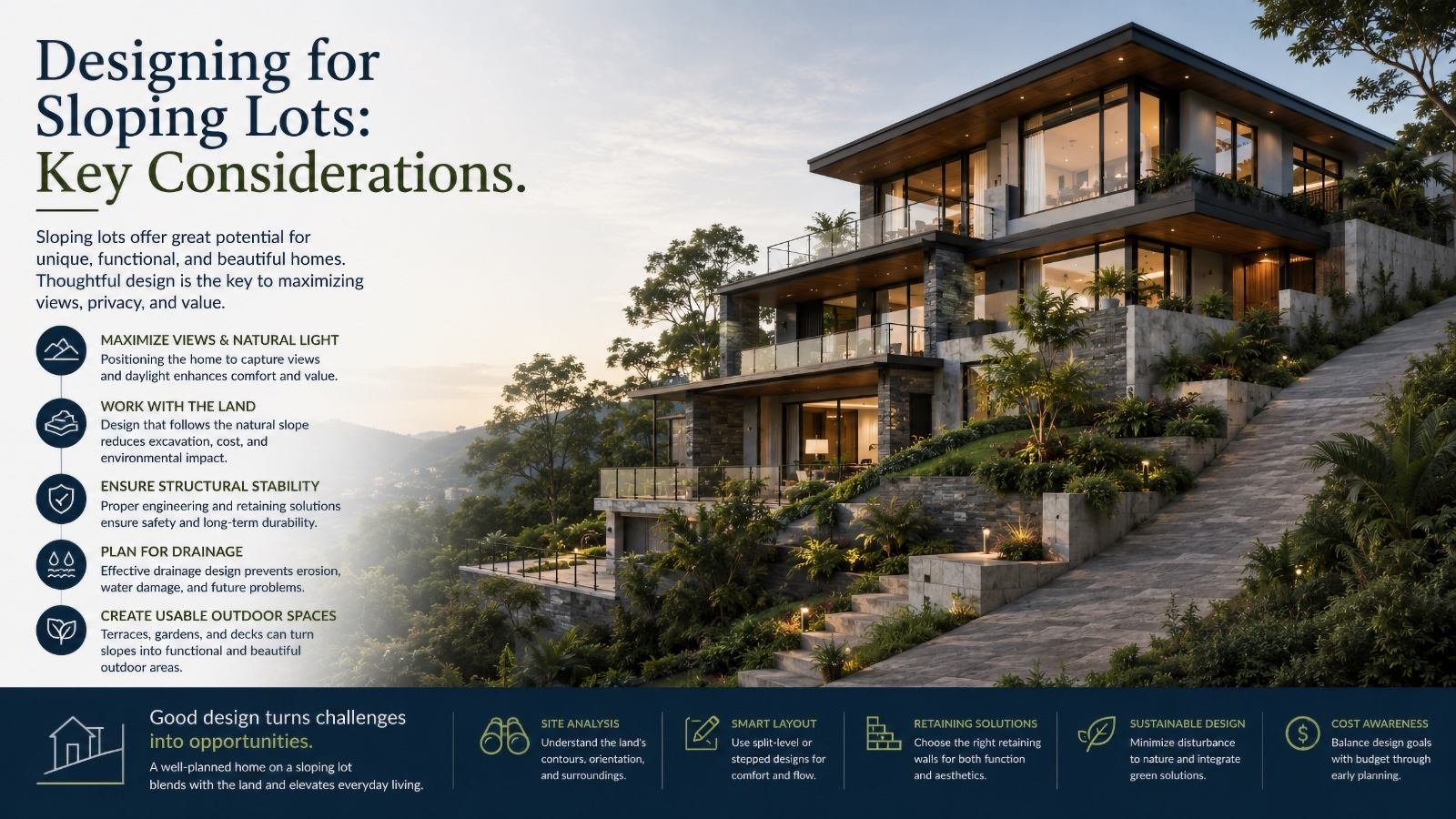
Maximize Views and Natural Light
One of the greatest advantages of a sloping site is the potential for exceptional views. Thoughtful positioning of the home can capture surrounding scenery while maximizing natural daylight and ventilation.
For many clients, particularly those building retirement homes or vacation residences, the relationship between indoor and outdoor spaces becomes a defining feature of the design. Proper orientation can enhance comfort, reduce energy consumption, and increase the long-term value of the property.
A well-designed home should celebrate its location rather than merely occupy it.
Work With the Land
A common mistake is attempting to force a sloping site into a flat-site solution. Excessive excavation and grading can significantly increase construction costs while disrupting the natural character of the property.
In many cases, designs that follow the natural contours of the land are both more economical and more environmentally responsible. Split-level layouts, stepped floor plans, and terraced outdoor spaces can create functional living environments while reducing unnecessary site disturbance.
The most successful hillside homes often appear to grow naturally from the terrain.
RELATED PROJECT
The Taylor Residence in Baguio City was designed on a steeply sloping site where access occurs from the highest point of the property. Instead of forcing the terrain into a conventional solution, the residence was organized to step naturally down the hillside across three levels. The project demonstrates how careful planning can transform a challenging slope into an opportunity for better views, improved site integration, and a distinctive living experience.
The Taylor Project
Ensure Structural Stability
Building on sloping terrain requires careful engineering evaluation. Soil conditions, slope characteristics, foundation systems, and retaining structures must all be properly considered during the planning process.
While these requirements may increase design complexity, they are essential for long-term safety and durability. Proper engineering not only protects the structure itself but also helps safeguard the owner's investment.
Early geotechnical and engineering assessments are often among the most valuable investments that can be made on a sloping-site project.
Plan for Drainage
Water management is one of the most critical aspects of hillside development.
Without proper drainage design, runoff can contribute to erosion, foundation problems, retaining wall issues, and landscape damage. Effective drainage strategies should be integrated into the project from the earliest stages of planning rather than treated as an afterthought.
A comprehensive approach typically considers surface drainage, roof runoff, site grading, retaining structures, and long-term maintenance requirements.
Create Usable Outdoor Spaces
A sloping site does not mean sacrificing outdoor living. In fact, terraces, gardens, decks, viewing platforms, and landscaped retaining walls can transform challenging terrain into some of the property's most enjoyable features.
Thoughtful landscape design can create a series of outdoor rooms that enhance both functionality and visual appeal. These spaces often become extensions of the home itself, encouraging outdoor living and strengthening the connection to the surrounding environment.
Turning Challenges into Opportunities
Every site presents opportunities and constraints. The objective of good design is not to eliminate every challenge, but to respond intelligently to the conditions that make each property unique.
At RG Chan & Associates, our approach begins with careful site analysis, including topography, orientation, drainage patterns, access, views, and environmental considerations. These factors help guide decisions regarding building placement, structural systems, circulation, and outdoor spaces.
For overseas clients considering retirement, vacation, or family homes in the Philippines, sloping lots often provide access to some of the country's most attractive locations. With proper planning and professional guidance, these sites can support homes that are both functional and exceptional.
After decades of experience, I have learned that challenging sites frequently produce the most memorable architecture. When approached thoughtfully, a sloping lot is not a problem to overcome—it is an opportunity to create a home uniquely connected to its setting.
Good design transforms constraints into possibilities, allowing the land itself to become one of the project's greatest assets.